Notified body fees under EU MDR & IVD R: what certification really costs
Quick answer: Based on our July 2026 analysis of the published price lists of more than 35 EU notified bodies, a QMS audit costs a median of ≈ €2,500 per auditor-day (range: €800–€4,900), technical documentation review runs €250–€465 per hour at most bodies (≈ €2,800 per reviewer-day median), application fees range from €0 to €8,000, and annual certificate maintenance from under €400 to over €10,000. A realistic first-cycle budget for a Class IIb device sits between €35,000 and €70,000 — before travel, consultation pass-throughs, and re-review rounds. The spread between the cheapest and most expensive body for the same activity can exceed 300%.
For years, notified body pricing was a black box. You would hear anecdotal numbers from colleagues — €10,000 here, €20,000 there, €200,000 total — with no way to verify any of it. That changed when the European Commission began publishing links to every notified body's standard fee list (required by MDR Article 50 and structured by the MDCG 2023-2 guidance). We collected and analysed all of them, normalised the currencies (most quote in EUR; a handful use SEK, NOK, PLN, CZK, DKK or HUF), and here is what the data actually says.
What you pay for: the four cost blocks every notified body charges
Almost every fee list follows the same MDCG 2023-2 structure, so your certification bill will be built from four blocks regardless of which body you choose:
Administrative charges — application fee, change-notification fees, certificate issuance, and an annual certificate maintenance fee.
Auditing — initial certification (Stage 1 + 2), surveillance, recertification, supplier/subcontractor audits, and the mandatory unannounced audit.
Documentation review — technical documentation (TD) assessment, clinical evaluation assessment (CEAR), SSCP validation, PSUR review, and assessment of changes.
Consultations and testing — expert panel and competent authority consultations, laboratory testing, batch verification (IVDR class D).
The template is standardised. The prices — and what is quietly excluded — are not.
The numbers: medians and ranges across 35+ notified bodies
You can download the official list issued by the European Commision, here:
| Cost component | Typical basis | Median (EUR) | Published range (EUR) |
|---|---|---|---|
| Application fee | Flat | ≈ 2,500 | 0 – 8,000 |
| QMS audit | Per auditor-day (8 h) | ≈ 2,480 | 800 – 4,900 |
| Technical documentation review | Hourly (200–508/h) | ≈ 2,800/day | 1,600 – 4,150/day |
| Annual certificate maintenance | Flat, often FTE- or class-scaled | ≈ 2,100 | 358 – 11,000+ |
| Unannounced audit | Per day or flat, min. 2 auditors | ≈ 4,250 | 2,000 – 9,600+ |
Currency-normalised at ECB reference rates, July 2026. Figures are published standard fees; quotes for your specific device will vary with class, complexity, sites, and headcount.
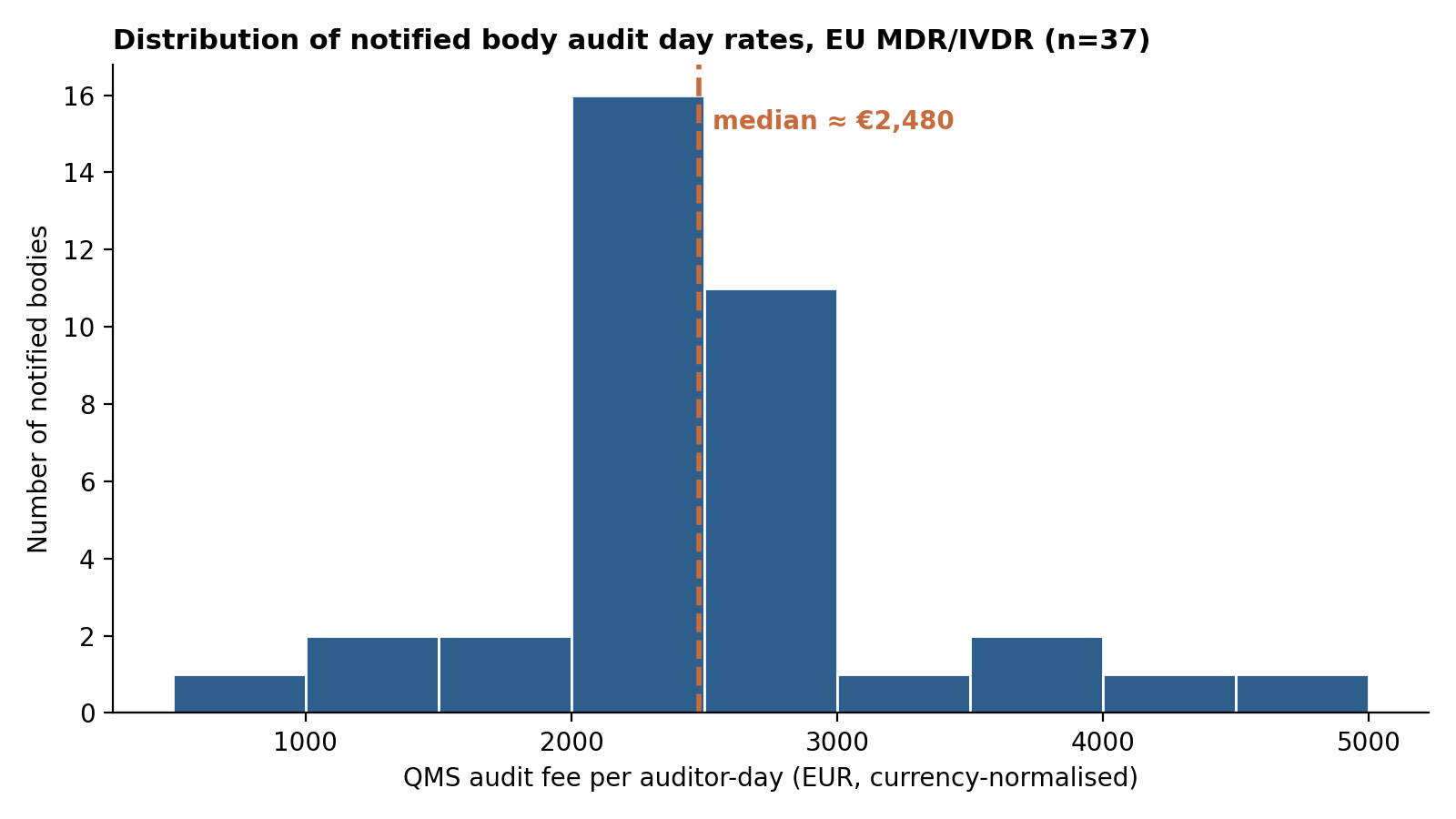
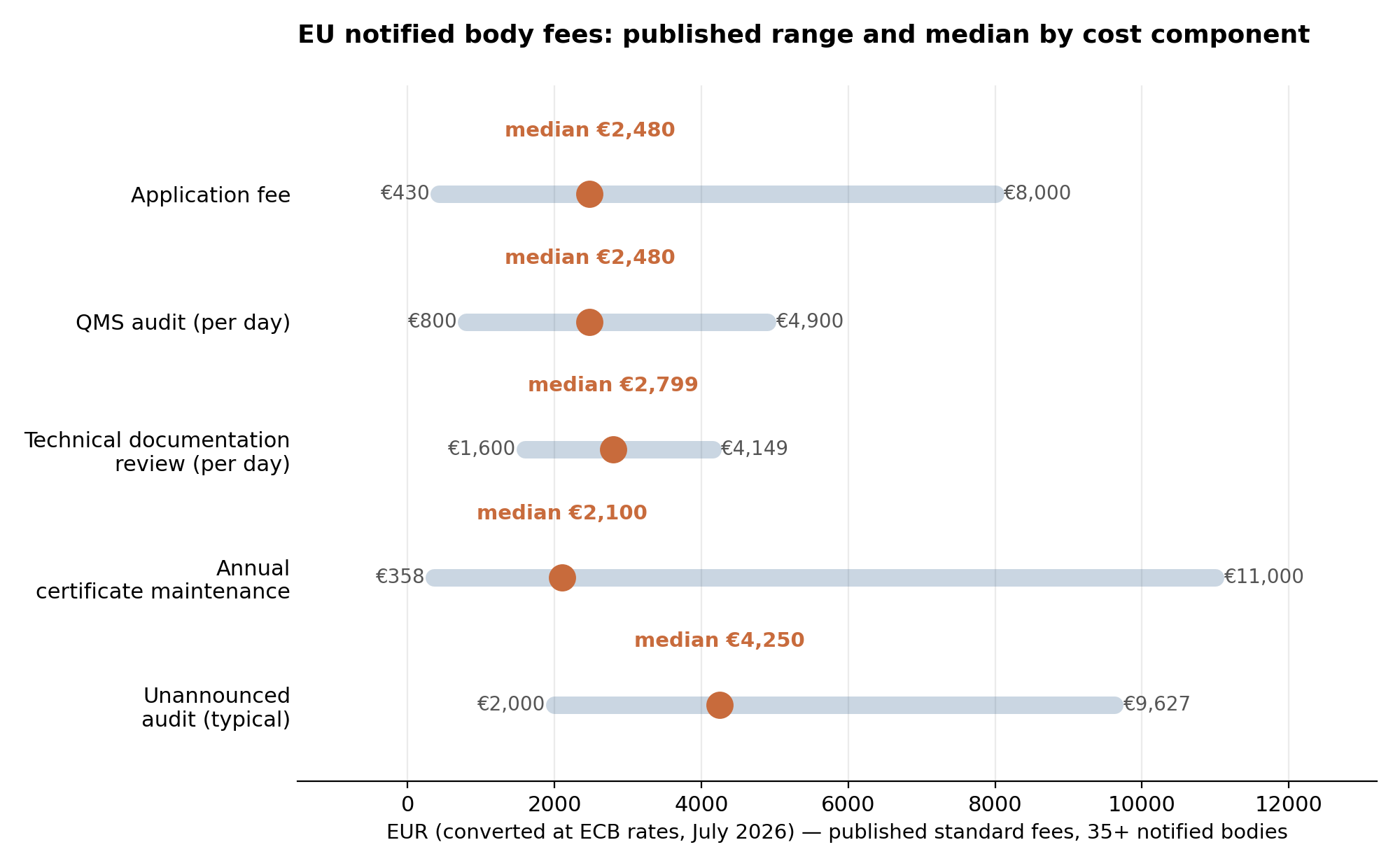
Three patterns stand out:
Documentation review costs more than auditing. Nearly every body prices TD and clinical review 15–35% above its audit rate. Reviewer time — especially clinical reviewer time — is the scarce resource, and several bodies charge €430–€465 per hour for clinical assessment specifically. For a Class III file, published TD review totals range from roughly €3,600 at the low end to more than €78,000 at the top.
Day rates converge; totals do not. Around three quarters of notified bodies charge €2,000–€2,800 per audit day. The real variation is in how many hours or days they assign, minimum charges per file (one body sets a €20,000 minimum per technical documentation review), per-project management fees, and how many review rounds are included before extra charges start.
Where the body is based matters less than you think. Bodies in Central and Eastern Europe undercut Western European ones by only about 25–35% on day rates — and some price above their Western parent organisations. Choosing a notified body on geography alone is not a cost strategy.
The outliers
The data contains a few striking departures from the standard model — useful reference points when you evaluate quotes:
A subscription model. One newer entrant focused on software medical devices charges no hourly or daily rates at all: a one-off initial certification fee starting around €100,000 plus an all-inclusive service fee of roughly €5,000 per month. Five to ten times the conventional entry cost — but it bundles surveillance, change reviews, and maintenance that others bill separately.
State-run bodies. Two publicly operated notified bodies charge statutory tariffs far below market: audit days from as little as ~€750–€1,050 and annual maintenance under €400. Their designation scopes are narrower, and capacity is limited.
Class-indexed pricing. Several bodies scale application and annual fees directly with device class — at one, the annual certificate usage fee runs from €5,000 (Class I sterile/measuring/reusable) to €17,000 (Class III implantable). Same activity, same body: the class determines the price.
No application fee. One Nordic body charges nothing to apply — then prices technical documentation review as a flat ~€15,000 per file. Low entry cost is not low total cost.
The costs that are not in the headline rates
Every fee list we reviewed excludes items that will nonetheless appear on your invoice. Budget for
Travel time and expenses — always billed on top, at €80–€220 per hour of travel time plus actuals. For non-EU manufacturing sites this alone can add thousands per audit.
Consultation pass-throughs — expert panel, EMA, or competent authority fees for combination products, animal-tissue devices, and companion diagnostics are passed to you at cost, frequently plus a 10–20% handling charge.
Repeat review rounds — most bodies include one to three rounds of non-conformity resolution; after that, each round is billed extra (typically €350–€800 per round or at the hourly rate). Poorly prepared technical documentation directly multiplies your bill.
Unannounced audits — mandatory at least once per certification cycle, minimum two auditors, entirely at your cost.
SME status you failed to claim — nearly every body offers micro/small/medium-enterprise relief under Recommendation 2003/361/EC: discounts of 3% to 50%, capped application fees, or reduced audit durations. It is rarely applied automatically; you must document and claim it.
What this means for your budget: a worked example
For a single Class IIb device, one manufacturing site, well-prepared documentation, a realistic first-certificate budget looks like this: application and administration ≈ €2,000–€6,500; Stage 1 + 2 QMS audit (4–6 auditor-days) ≈ €10,000–€16,000; technical documentation and clinical review (4–12 reviewer-days) ≈ €11,000–€35,000; certificate issuance and first annual fee ≈ €2,000–€5,000; plus travel and contingency for one extra review round. Total: roughly €35,000–€70,000 for the initial cycle, with annual surveillance, PSUR review, and maintenance adding €8,000–€15,000 per year thereafter. Incomplete documentation, multiple sites, or a consultation procedure can push it well beyond that.
How to choose a notified body on more than price
The cheapest day rate is meaningless if the body lacks designation codes for your device, quotes an 18-month queue, or assigns twice the review hours. What actually matters:
Designation scope — is your device's MDA/MDN/IVR code within the body's designation? (Check NANDO before anything else.)
Capacity and lead time — application-to-certificate timelines differ by 6–12 months between bodies.
Fee structure fit — hourly models reward well-prepared submissions; flat class-indexed models reward complex devices; subscription models reward frequent software releases.
Included vs. billable — how many review rounds, which reports, whose travel.
SME terms — if you qualify, the difference between bodies' SME schemes can be worth more than the day-rate difference.
This is exactly the assessment we do for clients. QLE is a Belgium-based regulatory consultancy that helps medical device and IVD manufacturers select and prepare for the notified body best equipped for their specific device, budget, and timeline — and keeps the file audit-ready so you pay for one review round, not three.
FAQ
How much does a notified body cost for MDR certification? Published standard fees across 35+ EU notified bodies show a median of ≈ €2,500 per auditor-day for QMS audits and €250–€465 per hour for technical documentation review. A first certification cycle for a Class IIb device typically totals €35,000–€70,000; Class III runs higher, driven mainly by documentation review depth.
Why do notified body quotes differ so much for the same device? Day rates are similar across most bodies; quotes diverge on assigned review hours, minimum charges per technical file, project management and administration fees, included review rounds, and travel. Always compare the total scope of a quote, not the day rate.
Are notified body fees public? Yes. MDR Article 50 and IVDR Article 46 require notified bodies to make their standard fees publicly available, and the European Commission publishes links to each body's fee list. The level of detail varies widely — some publish full tariffs, others a brief note.
Do small companies pay less? Usually, if they claim it. Most notified bodies apply SME conditions under Recommendation 2003/361/EC — discounts up to 50% on specific fees, capped application charges, or reduced audit time. You must evidence your SME status; it is not automatic.
Can I switch notified bodies if mine is too expensive? Yes — certificate transfers are possible and several bodies publish specific transfer fees (typically a third of initial certification effort, or a fixed review charge). Transfers require a tripartite agreement between you, the outgoing, and the incoming body, and are worth modelling before your recertification is due.
What is the difference between a notified body, a PRRC, and an authorised representative? The notified body is the independent third party that certifies your device. The PRRC is your internal (or contracted) person responsible for regulatory compliance under Article 15. The authorised representative is the EU-based legal representative required for non-EU manufacturers. You may need all three — see our guide on PRRC vs Authorised Representative vs Importer.
Method note: analysis of standard fee lists published by 35+ notified bodies designated under MDR (EU) 2017/745 and IVDR (EU) 2017/746, collected July 2026 via the European Commission's published register of notified body fees. The data was manually reviewed, aggregated and synthesised, then cross-checked through three separate AI services; this article is based on those comparative findings. Non-euro fees converted at ECB reference rates of 14 July 2026. Figures are published standard rates; individual quotes vary. No individual notified body is named; all figures are medians, ranges, or anonymised examples drawn from public documents
Get your certification budget right the first time
Notified body selection support — we shortlist bodies by designation scope, capacity, and total cost of certification for your device, and prepare your application package. Book a 30-minute scoping call.
PRRC as a service — Article 15 requires every manufacturer to have a Person Responsible for Regulatory Compliance; micro and small enterprises may contract it externally. QLE provides qualified external PRRC coverage.
EU Authorised Representative — non-EU manufacturers need an EU-based AR before any notified body will certify. We act as your AR and handle EUDAMED registration.
Not sure which you need? Email info@qle.be with a one-line description of your device — we will tell you honestly what applies and what does not.